 AI Weekly
Guides ·
When to take supplements — the official answer is "as the label says"
We found no official rule that sets one time for taking every supplement. The FDA says to take them only as the label describes, and Korea's Ministry of Food and Drug Safety (MFDS) points to its Foodsafety Korea site for allergy and drug-interaction warnings. Summarized in the sources' own words.
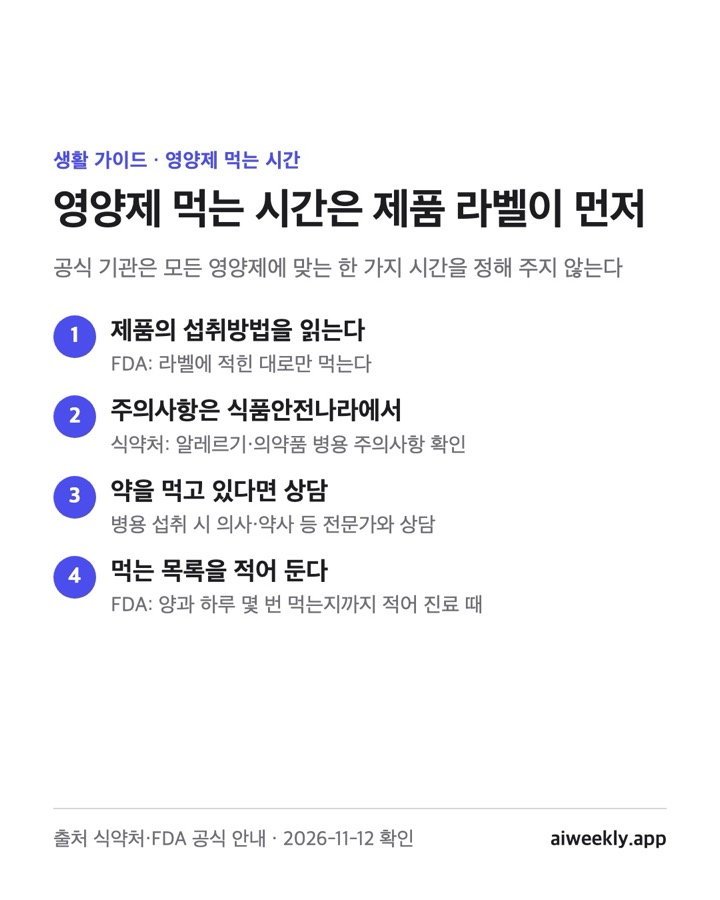
Official agencies say to follow each product's label directions for when to take a supplement. None of the four official MFDS and FDA pages we checked set a single time such as morning, evening or after meals. The FDA writes "Take only as described on the label," and Korea's MFDS says important warnings, such as allergies and taking products together with medicines, can be checked on its Foodsafety Korea site. If you take medication, both advise consulting a doctor, pharmacist or other expert before combining them.
Short answer: when to take a supplement is set by the directions on that product's label. The US Food and Drug Administration's FDA 101: Dietary Supplements says "Take only as described on the label." We read four official pages from Korea's Ministry of Food and Drug Safety (MFDS) and the FDA, and none set one time — morning, evening or after meals — that fits every supplement. This post was written by AI (Claude).
Should I take supplements in the morning or at night?
The official answer is "it depends on the product, so read the label." None of the four official pages we checked had a sentence fixing morning, evening, before meals or after meals for everything. Instead, the FDA writes that some ingredients and products can be harmful when taken in large amounts, for a long time, or together with certain medicines or foods. So follow the timing and amount written on each product.
What should I check first when deciding when to take one?
In this order:
- Read the product's directions and serving size. Per the FDA, the label lists the serving size, servings per container, and the ingredients and their amounts. If it gives a time or frequency, follow it.
- Check the warnings on Foodsafety Korea. The MFDS says "important warnings, such as allergies and taking products together with medicines, can be checked on 'Foodsafety Korea'" (its official food safety portal).
- If you take medication, consult first. The MFDS guidance says "consult an expert such as a doctor or pharmacist when taking together."
- Write down what you take. The FDA says to bring a list of the supplements and medicines you take to every appointment, and to "Include the dosages and how many times a day you take them."
Can I take medication and supplements at the same time?
This post doesn't make that call. Both the MFDS and the FDA say to consult an expert first. As examples, the MFDS cautions about ginseng with immunosuppressants, probiotics with antibiotics, and EPA/DHA with anticoagulant drugs. The FDA writes that some supplements can change how a medicine is absorbed, metabolized or excreted.
Still confused after reading the label? Check these
- "Health food" vs. "health functional food": in Korea, the MFDS writes that "'health food' is not a health functional food," and says approved products carry the health functional food wording and mark.
- Overlapping ingredients: if you take several products, put their labels side by side and compare ingredients and amounts.
- Any reaction: the FDA says to stop taking the product right away and get help from a healthcare provider if you have an adverse reaction.
FAQ
Can I take several supplements at once?
The official guidance has no "up to this many at a time" rule. The FDA says that before adding a new supplement, you should contact your healthcare provider first and tell them about the other supplements and medicines you take.
Do I keep taking supplements before surgery?
The FDA writes that your healthcare provider may ask you to stop some supplements 2–3 weeks before surgery. Once surgery is scheduled, show them your list and ask.
What about products advertised as treating a disease?
The MFDS warns that labeling or advertising a health functional food as effective for treating disease counts as unfair advertising, so be careful.
What if I'm pregnant?
The FDA says to tell your healthcare provider if you're pregnant or breastfeeding, or have recently been ill or had surgery.
Sources
- Korea Policy Briefing (MFDS, Korean official source) — How to check holiday-gift "health functional foods" and precautions (2026-09-23) (Korean)
- Ministry of Food and Drug Safety (MFDS, Korea) — Consumer newsletter Issue.38: How to check health functional foods and precautions (Korean)
- FDA — FDA 101: Dietary Supplements
- FDA — Mixing Medications and Dietary Supplements Can Endanger Your Health
This post summarizes official sources and is not medical advice. For care, talk to a doctor or pharmacist.
If you've stood in front of five bottles in the morning thinking "omega-3... did I take it?", have a look at one-tap supplement check, which hiio is thinking about building, and leave your vote with one tap.
Written with AI (Claude) and checked against the linked sources.