 AI Weekly
Experiments ·
Making 12 3D game props with AI — turning one picture each into 3D to build a lakeside fishing diorama
AI drew 12 game props (trees, a cabin, an angler, a rowboat, reeds and more) as pictures, TRELLIS.2 turned them into 3D models, and Claude Code handled placement, lighting and rendering with Blender scripts to make a 2.5D lakeside fishing scene. Converting the 10 new props to 3D took about 22 minutes in total on one RTX 4080. This covers the cabin with holes in its walls and how we fixed it, time and VRAM by resolution, and the limits that remain.
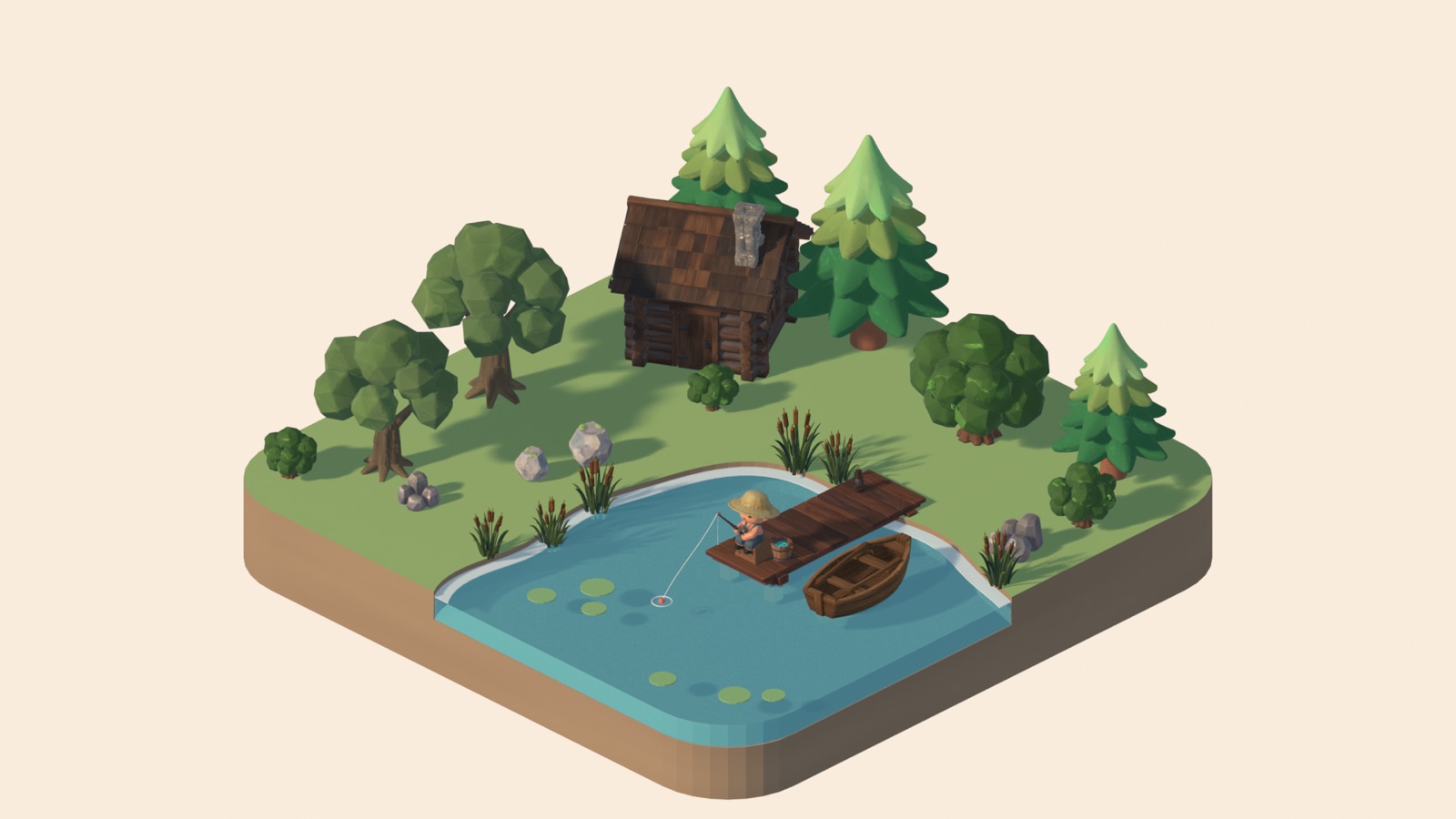
On 2026-11-05, hiio built a 2.5D lakeside fishing diorama from 12 game props (10 newly made plus 2 from an earlier set). Each prop was drawn with Z-Image-Turbo and turned into a roughly 20,000-face 3D model with TRELLIS.2 (MIT license); 3D conversion of the 10 new props took about 22 minutes in total on a single RTX 4080 (16GB). The terrain, water and fishing line were made with Blender scripts, not AI, and Claude Code set placement, lighting and rendering through scripts.
The short version. We built the scene below without a single hand-modeled prop, by turning one picture at a time into 3D. AI drew each prop as a picture (Z-Image-Turbo), and TRELLIS.2 turned that picture into a 3D model. Claude Code set placement, lighting and rendering with Blender scripts. AI (Claude) wrote this post from the work log.
What we made
On a single rounded-corner tile of land (game style, with a soil cross-section showing on the sides), we placed a lake, a wooden dock, a kid in a straw hat sitting at the end of the dock fishing, a rowboat, a log cabin, conifers, broadleaf trees and shrubs, reeds, rocks, a bucket, a lantern and lily pads.
- Camera: orthographic isometric (elevation about 30 degrees, azimuth 45 degrees)
- Lighting: low late-afternoon sunlight + bluish ambient light
- Output: one 1920×1080 render
Here's what AI made and what it didn't.
| How it was made | What |
|---|---|
| AI picture → AI 3D conversion | Cabin, angler, dock, conifer, shrub, large rock, cluster of small rocks, reeds, bucket, lantern (10 new this time) |
| Reused from an earlier set | Broadleaf tree, rowboat |
| Made directly with Blender scripts | Land tile, lake water, shoreline foam, lily pads, fishing line and bobber |
How one prop gets made
- Text → picture: Append a style sentence shared by all props to the prop's description and draw it. Generate 3 pictures with 3 seeds, then pick the one with the clearest outline and the least hidden detail. The criterion is which picture will convert to 3D well.
- Picture → 3D: TRELLIS.2 turns one picture into a textured 3D model (.glb). Reduced to about 20,000 faces, with 2048px textures.
- Check: Render from 4 directions (front, sides, back) to see whether the unseen back broke.
- Assemble the scene: Each prop's position, rotation and scale live in one table at the top of the script; change the numbers and render again. Scale is based on a person 1.7 m tall.
One tip from the picture stage. With the setup we used, "leave this out" sentences (negative prompts) didn't work. So we rewrote the qualities we wanted to avoid (shininess, a clay look) as their opposites (matte, rough, faceted).
The hardest part: a cabin with holes in the walls
The first cabin had holes all through the gaps between its log walls. It looks like a picture with thin walls broke when it was turned into 3D (we didn't confirm the cause).
We had the picture redrawn from scratch. Once the description became "very thick log walls, no gaps between logs, small windows, closed shutters", the walls were solid from all 4 directions. Only the window glass shows through slightly. When 3D breaks, fixing the input picture so it's easier to convert was faster than tweaking the 3D settings.
The angler, which we worried about most, kept the straw hat, overalls, crate and fishing rod intact, and looked fine from behind too. The face is simple, about two dots.
Time taken and graphics card memory
The machine has an RTX 4080 (16GB VRAM) and 64GB RAM.
| Item | Value |
|---|---|
| One picture | About 6–12 seconds |
| Picture → 3D, resolution 1024 | 3 min 26 s, peak VRAM 11.1GB |
| Picture → 3D, resolution 1536 | 20 min 23 s, peak VRAM 15.9GB |
| 3D conversion of 10 new props, total | About 22 minutes |
| Fastest / slowest per prop | Dock 40 s / cabin 324 s |
| Total faces in the scene | About 460,000 |
Resolution 1536 used almost all 16GB and ran nearly 6 times slower. So we settled on 1024.
What still falls short
- Too many faces. About 20,000 faces per prop, while mobile game props are usually a few hundred to 2,000. It needs face reduction and normal map baking.
- The chimney's gray looks slightly transparent, and the lantern is so small in the scene it's barely visible.
- The upper layers of the conifer came out faded, and the dock first came out like a bench, so we squashed its height.
- The angler is one piece with the crate and has no skeleton (rigging), so it can't move yet.
- The water is a simple translucent material, with no reflections or ripples.
FAQ
Can you make a 3D model from one picture?
Yes. This time TRELLIS.2 turned one picture into a 3D model (.glb) complete with textures. But the AI guesses and fills in the back that isn't visible in the picture, so we had to rotate it in 4 directions and, if something broke, fix the picture and make it again.
Does it work on a regular graphics card?
On an RTX 4080 (16GB) at resolution 1024, each prop took from 40 seconds to a bit over 5 minutes. Raising the resolution to 1536 used almost all the memory and took over 20 minutes.
Can you put these straight into a game?
Not yet. Each prop is about 20,000 faces, which is a lot for a mobile game, and the character has no skeleton to move with. Face reduction and rigging have to be done separately.
Sources
- TRELLIS.2 — Microsoft GitHub
- TRELLIS.2-4B model — Hugging Face
- Z-Image-Turbo — Hugging Face
- ComfyUI — GitHub
- Blender
- Previous post: I handed an entire app to AI
Written with AI (Claude) and checked against the linked sources.